BARRIER-AWARE WAYFINDING
Accessible routing that adapts to elevators, ramps, and real constraints
End-to-end UX for barrier-aware navigation—clear tradeoffs, trust, and fast reroutes
Built for constraints: elevators outages, steep ramps, edge states (missing data), and fast reroutes.
Metrics: 8 screens • 10 components • iterations • usability checks
ROLE
UX Designer
EXPERTISE
Customer-facing UX • Interaction Design • Systems
YEAR
2025
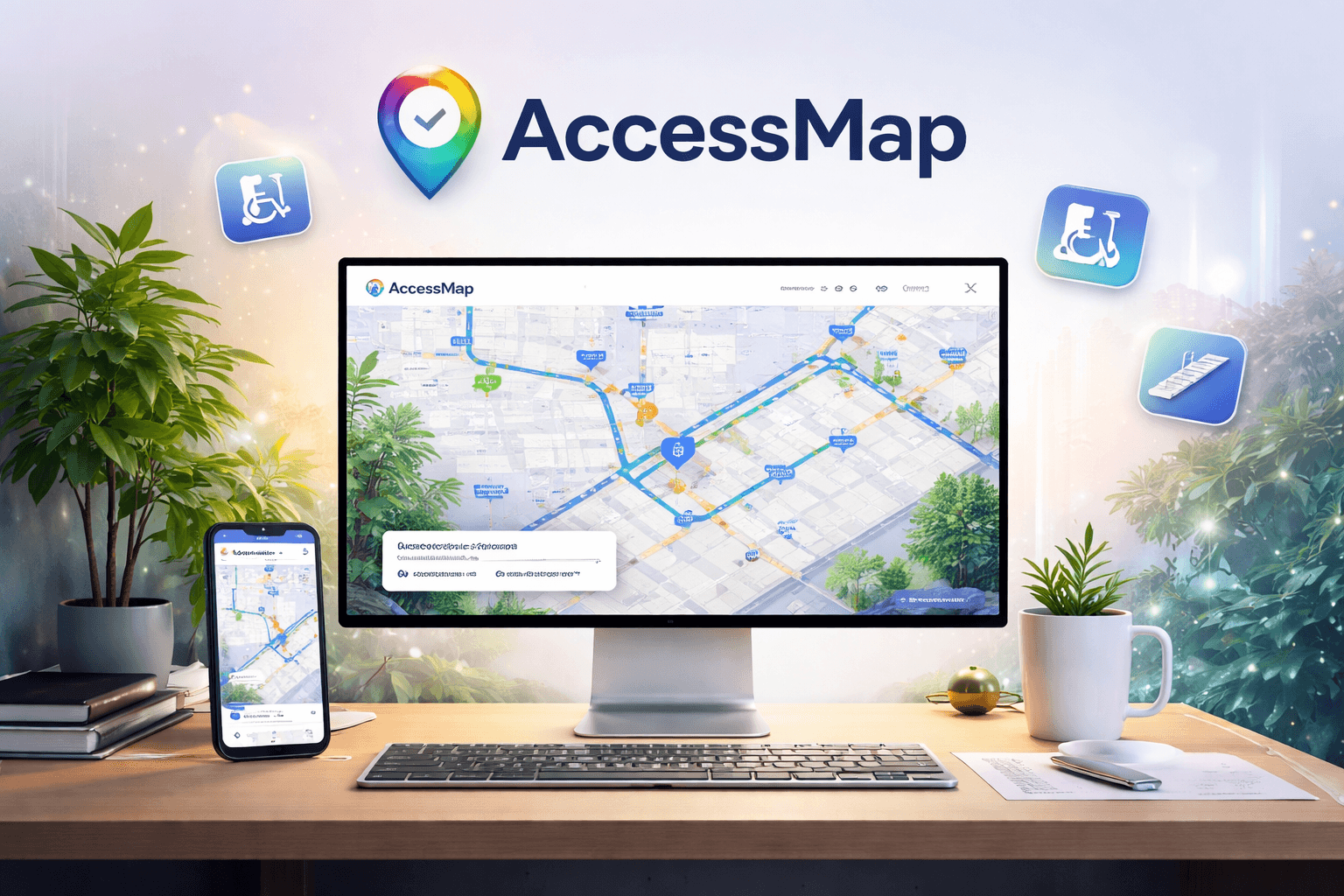

AccessMap is an accessibility-first navigation experience that helps people choose routes that match real mobility constraints—not just the shortest path. It reduces uncertainty by surfacing step-free options, slope/grade, curb cuts, surface quality, and temporary barriers (elevator outages, construction), so users can move confidently. The system is built for fast iteration: clear flows, reusable components, and edge states (missing data, conflicts, reroutes) that keep routing trustworthy even when the map isn’t perfect.
Timeline
4–6 weeks (discovery → requirements + constraint mapping → IA + route logic → flows → hi-fi UI → interactive prototype → usability checks + iteration)
Why this matters
Most maps assume a “default body.” For wheelchair users, people with injuries, seniors, and caregivers, stairs/steep slopes aren’t a minor inconvenience—they’re a hard stop. AccessMap reframes routing as a customer trust problem: if constraints aren’t visible, users can’t plan safely. By making accessibility signals explicit and designing resilient fallback states, AccessMap enables inclusive navigation that scales across cities and keeps users in control.
I treated this as a high-stakes UX problem where reliability, clarity, and accessibility are non-negotiable—because the cost of a wrong route is real.
1) Cross-functional + constraints
Partnered with PM + Engineering to translate [accessibility constraints + data gaps] into user flows, edge states, and handoff-ready specs—shipping under real technical constraints.
2) Templates/flows/diagrams
Used templates to rapidly produce process flows, conceptual diagrams, and IA—aligning stakeholders early and reducing rework downstream.
3) Fast iteration
Iterated quickly on flows → wireframes → hi-fi mocks → prototypes, incorporating feedback, usability signals, and feasibility constraints to refine the routing.
Research & Insights
Identified primary user groups: wheelchair users, cane users, stroller users, travelers with luggage, and people with temporary injuries.
Mapped core jobs-to-be-done:
Reach destination without barriers (no stairs / unsafe slopes).
Know what to expect before starting (surface, incline, curb cuts).
Recover fast when conditions change (outages, closures, missing data).
Found key pain points:
Uncertainty (hidden stairs/ramps, “step-free” claims not reliable)
Anxiety from last-minute obstacles
Lack of route confidence and limited fallback options
Confusing tradeoffs (shorter vs safer vs smoother)
Problem framming
How might we make accessibility constraints (steps, slope, surface, outages) understandable and controllable—so users can trust a route before they commit and recover instantly if reality changes?
Information Architecture & Flows
Designed flows around decision moments, not screens:
Route selection: compare accessible options with clear badges (step-free, low-slope, smooth surface).
Route explanation: “Why this route?” breakdown (tradeoffs, risk flags, confidence).
Navigation: live guidance + proactive alerts (upcoming steep segment, missing curb cut, elevator outage).
Recovery: one-tap reroute + report barrier + switch to safer mode (minimum-risk route).
Validation & Iteration
Prototype testing focused on:
Time to choose a safe route (decision speed without confusion)
Comprehension of slope/steps info (users can predict effort + risk)
Confidence before starting navigation (trust signal clarity) Iterated on filter clarity, route badges, and “Explain this route” affordances—reducing ambiguity and improving decision confidence.
AccessMap turns messy, real-world accessibility constraints into a calm, trustworthy navigation experience—so users can choose confidently, know what to expect, and recover instantly when conditions change.
1) Design system contribution
Built reusable components + variants (tokens, layout rules, states) and contributed patterns to a scalable design system for consistent UI across features.
2) Prototyping + spec handoff
Delivered clickable hi-fi prototypes + clean specs (redlines, variants, empty/loading/error/recovery) and supported implementation with dev collaboration + QA.
Step-free and Low-stress routing
Users can choose routes using clear, controllable constraints:
Step-free mode (avoid stairs entirely)
Max slope tolerance (e.g., gentle / moderate / strict)
Surface quality filters (smooth / uneven / unknown) Elevator status preference (avoid outage risk when possible)
Curb-cut presence (prefer confirmed curb cuts)
Confidence-based route cards
Each route includes decision-first clarity:
Accessibility badges (steps, slope, surface, curb cuts, elevators)
Confidence score (data coverage + recency + community verification)
“Why this route?” explanation (tradeoffs + risk flags + what to expect)
Fallback options (safer alternative + minimum-risk route)
Community-powered reporting
Reliability improves through lightweight reporting:
Report barriers in 2 taps (stairs, blocked ramp, broken elevator, construction)
Upvote / verify reports to strengthen trust signals
“Last verified” timestamps + source labels (sensor/community/official)
Route warnings update quickly to prevent surprises mid-tri
Outcomes from AccessMap’s end-to-end UX work—focused on reducing route uncertainty, improving decision speed, and building trust for accessibility-critical navigation.
Faster route decisions
Route cards + accessibility badges helped users compare options quickly instead of scanning maps blindly.
Impact → Faster “safe route” selection, fewer back-and-forth checks, lower decision fatigue.
Higher confidence before starting navigation
“Why this route?” explanations + visible constraints (steps/slope/surface) made difficulty predictable upfront.
Impact → Fewer surprises mid-trip, reduced anxiety, stronger trust in the system’s recommendations.
Better recovery when the real world changes
One-tap reroute + barrier alerts supported quick recovery during elevator outages, construction, or missing data.
Impact → Fewer failed trips, smoother continuation even on imperfect routes.
More reliable experience through feedback loops
Community reporting + verification signals improved data quality and kept routes current.
Impact → Higher confidence over time, clearer “last verified” cues, stronger long-term usability.